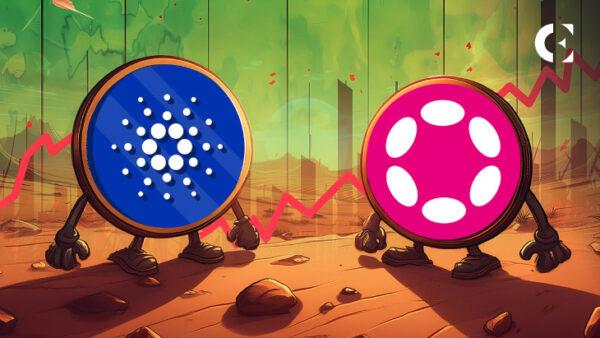
PolkadotPrice(DOT)
Details Polkadot (DOT) Price information (USD)
The current real-time price of DOT is $1.267. In the past 24 hours, DOT has traded between $1.247 and $1.302, showing strong market activity. The all-time high of DOT is $55.00497, and the all-time low is $1.130321.
From a short-term perspective, the price change of DOT over the past 1 hour is
Polkadot (DOT) Market Information
Polkadot (DOT) Today's Price
The live price of DOT today is $1.267, with a current market cap of $2.125B. The 24-hour trading volume is 124M. The price of DOT to USD is updated in real time.
Polkadot (DOT) Price History (USD)
What is POLKADOT (DOT)?
When is the right time to buy DOT? Should I buy or sell DOT now?
Before deciding whether to buy or sell DOT, you should first consider your own trading strategy. Long-term traders and short-term traders follow different trading approaches. LBank’s DOT technical analysis can provide you with trading references.
Future price trend of DOT
What will the value be? You can use our price prediction tool to conduct short-term and long-term price forecasts for DOT.
How much will DOT be worth tomorrow, next week, or next month in ? What about your DOT assets in 2025, 2026, 2027, 2028, or even 10 or 20 years from now? Check now! DOT Price Prediction
How to buy POLKADOT (DOT)
Convert DOT to local currency
DOT Resources
To learn more about DOT, consider exploring other resources such as the whitepaper, official website, and other published information:
Official DOT website
Blockchain explorer
Top 5 addresses | Holding amount | Holding ratio | |
|---|---|---|---|
ethereum | 0x0000...e08a90  | 1,959 | 0.29% |
base | 0x7f72...99b512 | 1,948 | 0.29% |
base | 0x7f72...99b512 | 1,948 | 0.29% |
ethereum | 0x1d42...b0549b | 1,757 | 0.26% |
ethereum | 0xc1f7...545347 | 1,132 | 0.17% |
Other | 655.939K | 98.68% |
Hot Events

POLKADOT (DOT) FAQ
What is Polkadot, what problem does it solve, and who are its founders?
Polkadot is a Layer 0 meta-protocol designed to connect various specialized blockchains (parachains), enabling secure and trustless data and asset transfers across them. This framework aims to build a scalable and interoperable multi-chain ecosystem. It was co-founded by Dr. Gavin Wood (co-founder of Ethereum), Robert Habermeier, and Peter Czaban, with development supported by the Web3 Foundation.
How does Polkadot's architecture enable shared security and what is its transaction throughput?
Polkadot operates with a central Relay Chain that provides shared security and consensus, but does not support smart contracts directly. Instead, specialized Parachains connect to the Relay Chain to leverage this security and achieve interoperability, hosting smart contract functionality (e.g., via Moonbeam or Astar). With Polkadot 2.0, the JAM protocol is bringing native smart contract focus. Unlike single-chain networks, Polkadot's throughput scales with its parachains, designed to process thousands of transactions per second across the entire ecosystem.
What are the primary uses for the DOT token?
The DOT token serves multiple core functions: Governance, allowing holders to vote on network upgrades via OpenGov; Staking, where users bond DOT to nominate validators and secure the network, earning rewards; and Coretime (formerly Bonding), used to purchase blockspace for parachains in the new Agile Coretime model. The network uses an inflationary model (around 10% annually) to incentivize staking, with no hard cap on supply. A redenomination occurred in August 2020, changing 1 Old DOT to 100 New DOT purely for manageability.
How can users earn rewards and secure the Polkadot network through staking?
Users can earn rewards by staking DOT, primarily through nominating validators in Polkadot's Nominated Proof-of-Stake (NPoS) system. While direct nomination on the Relay Chain typically requires a higher minimum (dynamically changing, often hundreds of DOT), Nomination Pools allow staking with as little as 1 DOT. It's crucial to maintain an 'active' account by keeping at least 1 DOT (the Existential Deposit) to avoid account deactivation. Be aware that validators and their nominators can be 'slashed' (lose DOT) if the validator misbehaves, ensuring network security.
What is Polkadot 2.0, and how does it change the network's blockspace model and future direction?
Polkadot 2.0 encompasses significant upgrades like Asynchronous Backing and Agile Coretime, transitioning from rigid parachain auctions to a flexible, cloud-like model for blockspace. This allows projects to purchase 'processing power' (Coretime) on demand. A major future focus is the JAM (Join-Accumulate Machine) protocol, envisioned to replace the current Relay Chain with a high-performance 'global computer' capable of supporting any service, not just specialized blockchains, making the ecosystem more adaptable and powerful.
What wallet options are available for Polkadot users, and what is the community's focus regarding adoption?
For managing DOT, popular wallet choices include Polkadot.js (for advanced users), Talisman, SubWallet, and Nova Wallet (a mobile option). The Polkadot ecosystem has historically emphasized deep engineering and robust decentralization over aggressive retail marketing. However, there's a growing shift towards more user-focused initiatives and improved community engagement to simplify the user experience and expand adoption, addressing concerns about perceived complexity.
Important POLKADOT (DOT) industry updates
Time (UTC+8) | Type | News |
|---|---|---|
01-16 02:39:12 | Market Information | Polkadot (DOT) is experiencing significant positive momentum with several key developments. Proposed network upgrades in January 2026 aim to cap issuance at 2.1 billion, enable Solidity smart contracts, and reduce block times to two seconds, alongside a 40% latency reduction. Robinhood's recent listing on January 13 expanded retail access after DOT's non-security classification. The asset saw a 10% technical breakout on January 14, surging to $2.32. Analysts are optimistic about Polkadot 2.0 and Coreplay, forecasting 2026 prices from $4-$6, with bullish scenarios up to $15-$25, driven by enhanced interoperability and efficiency. |